Highly qualified professionals united by 1 target: conducting analysis of the current Forex conditions

FXPrestige has been enlarging its staff with the goal to provide its customers with comprehensive and highly reliable analytics.

Awesome customers support services by dedicated professionals

- Dedicated Support Areas - Comprehensive Contacts Information - Credible Introducing Offices - Callback Service - Journalist Inquiries -

FXPrestige - Future Leader In Online Trading!

We open new HORIZONS for opportunities...

Forex learning course for beginners by FXPrestige

Exclusive distance course, written by the company's traders and analysts, based on the most popular and user-friendly MetaTrader 4 platform.

Today, FXPrestige services are of great interest for thousands of traders and partners all over the world

Offering the most generous and rewarding affiliation and partnership programme globally.

Showing posts with label View and Opinion. Show all posts

Sunday, 16 April 2017

Trump And Yellen May Not Be An Odd Couple After All


By Howard Schneider and Ann Saphir
WASHINGTON (Reuters) - At first glance, U.S. President Donald Trump and Federal Reserve chair Janet Yellen may have little in common.
Yellen is an academic economist and veteran of Democratic administrations who is committed to an open global economy, while Trump is a real estate mogul with an electoral base suspicious of the economic order Yellen helped to create.
Yet the two may have interests in common now that Trump is president and both want to get as many Americans working as possible.
Since her appointment as Fed chair in February 2014, Yellen has kept interest rates low and she currently pledges to raise them only slowly even though unemployment, at 4.5 percent, is at its lowest in nearly ten years.
Meanwhile, Trump's election campaign promises to cut taxes, spend money on infrastructure and deregulate banking, have helped propel a surge in the U.S. Conference Board's consumer confidence index to its highest level since the internet stocks crash 16 years ago.
Former Fed staff and colleagues who know Yellen said Trump's surprising remarks this week in a Wall Street Journal interview, in which he did not rule out Yellen's reappointment to a new four year term next year, are not as outlandish as they may appear now that the president has a vested interest in keeping markets and the economy on an even keel.
And the same staff and colleagues say Yellen may well accept reappointment, despite Trump's criticism of her during last year's election campaign.
Many in Trump's Republican party have called for tighter monetary policy and a less activist Fed, but "the president would not really find that useful," said former Fed vice chair Donald Kohn.
If Trump fills three existing Federal Reserve board vacancies with people Yellen thinks she could work with, "it would be really difficult to turn down" a reappointment when her term as chair expires in February 2018.
"If she continues to do well, he’d be nuts to ditch her for an unknown quantity," said University of California, Berkeley, economics professor Andrew Rose, a long-time colleague and co-author with Yellen of an oft-cited study of labor markets.
Yellen took over from Ben Bernanke as Fed chair in February 2014 with the U.S. economic recovery from the 2008 financial crisis still on shaky ground, and she has made no secret she puts a priority on growth in jobs and wages and a broad recovery in U.S. household wealth.
In a slow return to more normal monetary policy, Yellen has stopped the purchase of additional financial securities by the Fed and in December 2015 began raising short term interest rates for the first time in 10 years.
So far those policy shifts have been engineered with little apparent impact on job growth, and so mesh with Trump's core election campaign promises to restore employment and earnings.
The slow rise in interest rates in the past year has also happened while U.S. stock prices have risen to record highs, though Trump has claimed the credit for himself.
PRECEDENT FOR FED CHAIR TO STAY ON
There is precedent for Trump to stick with a former president's Fed chair appointment. Paul Volcker, Alan Greenspan and Ben Bernanke, the three previous Fed chairs, served at least two four year terms and were nominated by both Democratic and Republican presidents.
However it may be a more difficult step for Trump.
During last year's election campaign, Trump accused Yellen of accepting orders from then President Obama to keep interest rates low for political reasons, and he said he would replace her as Fed chair because she is not a Republican party member.
In a particularly biting moment last year, in a campaign video advertisement, he labeled her as among the "global special interests" who had ruined life for middle America.
The Fed on Thursday said it had no response to Trump's comments published on Wednesday on Yellen and or on whether Yellen would consider a second term.
MUCH COULD STILL GO WRONG
Some of Trump's advisers and some Republican lawmakers want a more conservative Fed in which the chair has less power and would see a Yellen reappointment as yet another step away from his promise to "drain the swamp" of the Washington establishment.
There are also three current vacancies on the Fed's seven member Board of Governors, and unorthodox new members could make it difficult for Yellen to manage policy or accept another four year term.
But if the choice is her consensus style or someone unproven in their ability to manage public and market expectations, "he'd be wise to reappoint her," said Joseph Gagnon, a former Fed staffer and Berkeley colleague of Yellen's currently at the Peterson Institute for International Economics.
"I don't see what is in his interests to appoint someone who is going to jack up interest rates."


Sunday, 9 April 2017

Is The Yen A New Safe Haven Currency?


As U.S. warships rained Tomahawk missiles onto a Syrian airbase Thursday night, currency traders began positioning themselves for safety.
It was not, however, the dollar that benefited. It was the yen.
It’s an odd turnabout. The yen, after all, represents the economy with the world’s greatest debt burden (in terms of debt to GDP). The yen, as well, is the sacrificial lamb in Japanese government’s plan to revitalize a long-moribund economy by continually printing currency.
And yet, the moment that global troubles bubble up, the world’s currency traders reflexively rush into the yen.
The question is why?
The answer to that question is tied why we believe that well diversified investors should have exposure to yen in the current environment – and by “current” we don’t just mean with missiles falling on Syria. We mean in the current global environment that has 1) the U.S. struggling under a new presidential administration that has yet to find any cohesion, and which has thrown out some challenging ideas related to global trade; 2) Europe still facing the after-effects of the Greek debt crisis and the additional burden of a migrant crisis that could spark hostilities; 3) North Korea rattling sabers and the possibility that President Trumps reacts aggressively; and 4) China trying to redefine its zone of influence in the Asia-Pacific region and the reactions that it stirs up.
In addition, there remains the possibility that the global financial crisis of a decade ago has not fully run its course. Central bankers across the West threw gobs of money at the crisis through Quantitative Easing programs and other campaigns to inject capital into the global economy. This strategy worked to reflate paper-asset prices and save a few large banks, but it did not vanquish the systemic disease – namely, the vast accumulation of debt in the West that has grown larger in the last decade and which could seriously hurt the globally economy.
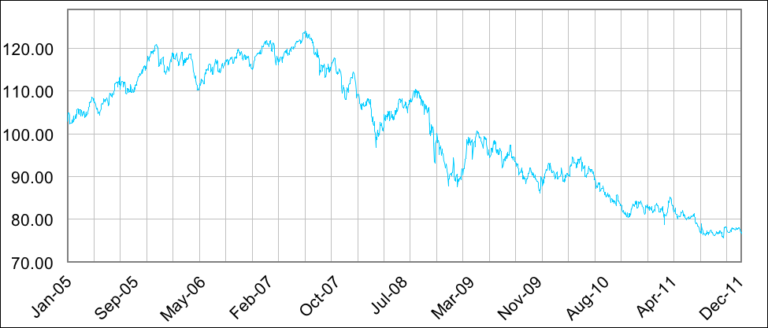
If an upset of some sort spreads fear through the global economy, the truly safe haven will be the Japanese yen – as it was during the global crisis, when it was the one notable asset to rise in value against the dollar as everything else crumbled. As this chart shows, the buck lost more than 47% against the yen from summer of 2007 (just before the crisis began) to early 2012. Or, another way to view this is that the yen gained more than 60% on the dollar.
The Dollar’s Slide Against the Yen

So Why the Yen: 2 Primary Reasons

Reason #1: Along with being the world’s most indebted nation, Japan, as a country reliant on exports, also holds title as the world’s largest creditor nation. The implication is that a lot of yen is floating around outside of Japan.
When a crisis erupts, the Japanese repatriate that money – they bring it back home. In that process, they’re selling assets in other currencies to buy yen. And at that point it’s a supply/demand issue. The supply of others currencies is rising as the Japanese pull out (those currencies fall in value) and demand for yen rises as the Japanese bring their money back home (the yen rises in value).
Reason #2: Japan offers some of the lowest interest rates in the world … -0.1%.
Because of that, the Japanese export their money overseas as part of the “carry trade.” They sell the yen (increased supply, downward prices) to buy other currencies with higher yields. In that process, they capture the spread between low yen yields and higher yields in currencies such as the U.S. dollar, as well as the Aussie and Kiwidollars.
But, again, when crisis erupts, the Japanese (and other currency traders around the world playing the carry trade) close their positions and return to the yen … which gets back to supply and demand.
This is the reason the yen benefited from the bombing of Syria. Yet, the impact won’t be long-lived, most likely, because the Syrian issue will be fleeting. But the episode serves as evidence that the yen may well be a safe haven for diversified investors.
Grey swans have taken flight. If one lands, the yen may be a winner.
In Wealth & Prosperity,

Geopolitical Risks Front and Centre for Forex Traders


By Kathy Lien, Managing Director of FX Strategy for BK Asset Management.
Geopolitical risks are front and center for forex traders this month with terrorist attacks in Russia and Sweden and the U.S. airstrikes in Syria putting investors on edge. U.S. data took a backseat to these developments, resulting in a messy end to a busy trading week. The China–U.S. summit ended the best way possible — with no shots fired from either side. Instead, President Trump said “tremendous progress” was made and declared the U.S. relationship with China as “outstanding.” Without going into details he also said “I believe lots of very potentially bad problems will be going away.” In a statement released by China, President Xi told Trump, “We have a thousand reasons to get China–US relations right and not one reason to spoil the China–US relationship.” While President Xi won’t be happy with the U.S. attacks on Syria (as their views are more closely aligned with Russia), this was the best ending that the markets could have hoped for from one of this week’s most dangerous event risks. Meanwhile, we believe that the weakness in March Nonfarm Payrolls will come back to haunt the dollar as the market looks forward to the latest U.S. retail sales and core cpi reports. Geopolitical risks and softer U.S. data could keep investors risk averse, leading to weakness in USD/JPY and other highbeta currencies like the euro. The U.S. decision to take direct military action in Syria is shifting U.S.–Russian relations and that could be bad news for the markets. Fox News reported that a Russian warship has entered the eastern Mediterranean heading toward 2 US Navy destroyers that launched airstrikes last night. While many investors may be confused by USD's quick recovery post-payrolls, the move was driven by a combination of short covering, the positive outcome to the U.S.–China summit and a flight to safety into U.S. dollars.
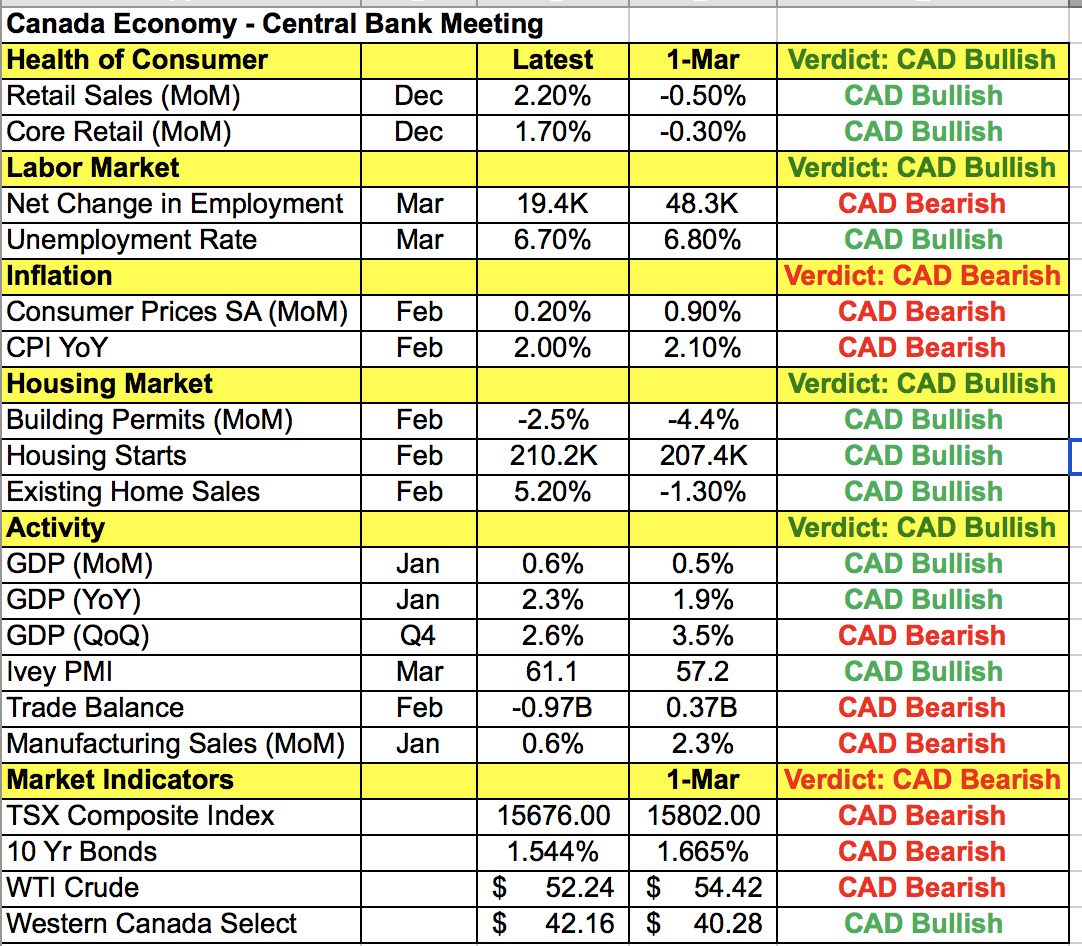
Stronger-than-expected Canadian data and a rise in oil priceshelped the Canadian dollar stave off further losses. Syria is not a major oil producer but its geographic location and alliances with major Middle East oil producers raises fear for additional uncertainty in the region. The latest Canadian economic reports were strong with Canada adding another 19.4K jobs in March. Full-time and part-time jobs increased, indicating that there was no letup after the strong rise in February. The IVEY PMI index also jumped to 61.1, its highest level in more than a year. All of these developments are important going into Wednesday’s Bank of Canada monetary policy announcement. This month’s meeting will be more market moving than last month’s because it will be followed by a press conference from Bank of Canada Governor Poloz. The last time the central bank met, it expressed concern over low wage growth, slack and the competitive challenges faced by the export sector. In the past month, economic activity has been uneven. The pressure on exportsintensified with the trade balance returning to deficit in February. Inflation is also low with CPI growth slowing to 2%. Yet job growth, manufacturing activity and consumer spending have been strong. So we may not see any major changes to the central bank’s outlook. With that in mind, if the BoC hardens its dovish bias by reiterating its concerns, the Canadian dollar will sell off. However, if BoC emphasizes the improvement in spending and labor activity, USD/CAD will fall hard from its elevated levels.
CAD Data Points
CAD Data Points
The Australian and New Zealand dollars traded lower this past week with AUD/USD reaching 75 cents on the back of risk aversion. The latest Australian economic reports were mixed with retail salesand manufacturing activity slowing while service-sector and trade activity grew. These contradictory reports created more confusion than clarity and gave investors very little reason to buy AUD. In the coming week, Australian labor data and China’s trade balance will be the numbers to watch. The RBA has recently expressed concern about the labor market, which makes this month’s report particularly important. China’s trade balance will most likely rebound after the unexpected deterioration last month. There’s quite support for AUD/USD at 75 cents but it is looking risky. As there are no major New Zealand economic reports scheduled for release in the new trading week, NZD will most likely take its cue from AUD, regional data and the market’s appetite for U.S. dollars.
After trading in an exceptionally tight range for most of the week, the euro finally broke down on Friday, falling to its lowest level versus the U.S. dollar in 3 weeks. The move had nothing to do with data as German industrial production and trade activity improved in February. Instead, ongoing terrorist attacks in Europe are making investors nervous about Marine Le Pen’s chances of becoming the next President of France. She is running on a campaign of anti-immigration, anti-terrorism and the latest polls show her virtually neck and neck with Emmanuel Macron going into the first round of voting on April 23. The latest terror attacks probably won’t make it into next week’s ZEW survey but we continue to expect the euro to trade with a heavy bias despite improving domestic conditions. At the same time, ECB officials are still worried about inflation — central bank President Draghi said this past week that it is clearly too soon to declare success on inflation and that ECB needs more inflation confidence to change its stance. As such, he sees no need to deviate from the wording of forward guidance even as the balance of growth risks seem to be shifting upward. ECB member Constancio agrees that it is too soon to declare success on inflation and Praet believes rates should stay at current or lower levels well past QE.
Finally, sterling ended the week lower against most of the major currencies. Data has been mostly weaker and is likely to worsen as the U.K. moves toward leaving the European Union. Although service-sector activity accelerated, manufacturing and constructionactivity slowed in March. Friday’s Halifax house price report, industrial production and the trade balance also missed expectations. Next week, we’ll get more insight into whether the hawkish dissent from BoE member Forbes at the last monetary policy meeting is justified. This past week’s data and the cautious comments from BoE member Vlieghe certainly puts her views into question. Vlieghe believes the BoE should be cautious as the U.K. consumer slowdown could intensify. The U.K.’s inflation and employment reports are scheduled for release next week. Inflation is an exceptionally important input into the central bank’s policy.

Sunday, 2 April 2017

USD To Q1: 'Don't Come Back'


By Kathy Lien, Managing Director of FX Strategy for BK Asset Management.
The first quarter has come to an end and it was a tough one for the U.S. dollar. Even a rate hike by the Federal Reserve failed to stem USD's slide, which lost approximately 5% of its value against the Japanese yen and Australian dollar. The lack of urgency among U.S. policymakers to follow up the March hike in June was the main cause of the weakness but the failed health-care bill, tax-reform uncertainty and mixed data also contributed to the move. On Friday we learned that personal income and spending growth slowed in February with inflationary pressures easing according to core PCE. Manufacturing activity in the Chicago region accelerated, which along with healthier data Monday through Thursday helped USD/JPY end the week higher. That included stronger GDP growth, a narrower trade deficit and a sharp rise in the Conference Board’s consumer sentiment index. It's also worth noting that the greenback managed to shrug off a report that President Trump is studying ways to “penalize currency manipulators” as part of his goal to fight unfair trade. Such measures would be aimed at pressuring other countries to strengthen the value of their currencies at the expense of the U.S. dollar.
Looking ahead, USD/JPY has resistance at 112 and support at 111. It will be a big week for the U.S. dollar with ISM reports, minutes from the most recent FOMC meeting and nonfarm payrollsscheduled for release. If the minutes confirm that the Fed is in no rush to raise interest rates again, the dollar could retreat. But if they contain a general tone of optimism, we could see 113 in USD/JPY. With that in mind, NFP is the most important piece of data to watch because economists are looking for slower job growth. If they are right, it could be a nail in the coffin for the dollar, leading to lower trading in the next few weeks.
When the British government invoked Article 50 of the Lisbon Treaty, the E.U. responded and sterling didn't blink. Instead, U.K. financial markets acted quite orderly with GBP/USD ending the week within 50 pips of where it started. There were intraweek swings but given the historical significance of this week’s developments, the swings could have been far greater. We knew this day would come but its inevitability does not minimize its significance — the U.K. is leaving the European Union and investors, businesses and individuals are bracing for the fall-out. So far, the pain has been minimal with GBP/USD recovering part of its recent losses. Friday morning, the EU submitted its response to the Article 50, giving the U.K. 1 year after it leaves the Union to work on a trade deal and only if it settles its financial commitments. Its not the worst-case scenario because they are willing to talk trade. Nor is it the best-case scenario because Britain needs to first “show sufficient progress” on its settlement of the Brexit bill, a payment it has previously refused to pay. Scotland also officially requested a referendum. While we believe that all of these developments are negative for GBP, the currency is trading well and we have to respect the price action as a result. Sterling traders are taking the Article 50 trigger, EU response and Scotland’s call for a referendum in stride and if that continues, GBP/USD could squeeze up to 1.26. U.K. fundamentals will return to focus next week with the March PMIsscheduled for release. The recent hawkishness dissent in the Bank of England leads many to believe that the economy continued to improve last month.
It was a tough week for the euro. Although more than 30K people fell off German unemployment rolls and retail sales in the Eurozone’s largest economy grew strongly according to the most recent reports, inflation is moving in the wrong direction with CPI growth slowing to 1.5% from 2%. A number of ECB officials have talked about the possibility of a rate hike but we think that will be very difficult until inflation starts to rise. The first round of the French election will be a key focus in April and so far it appears that Emmanuel Macron holds a comfortable lead over Marine Le Pen. As April 23 nears, the euro’s sensitivity to the polls will increase significantly. In the meantime, the account of the most recent ECB meeting, German industrial production and trade along with U.S. data will drive EUR/USD flows. Technically, EUR/USD looks weak but there is also support near 1.0650.
Meanwhile, there was very little consistency in the performance of the commodity currencies this past week. The Australian dollar ended the week unchanged (though it performed well in the first quarter), the New Zealand dollar weakened and the Canadian dollar strengthened. AUD was supported by stronger Chinese data while faster growth in Canada and higher oil priceslifted the loonie. CAD GDP growth accelerated to 0.6% in January, driving year-over-year growth to 2.3% from 2.1%. AUD and CAD remain in play with the Reserve Bank of Australia’s monetary policy announcement and Canadian employment plus trade data scheduled for release next week. Business activity appears to have slowed a bit in Australia since the last monetary policy meeting but we’ll get more clarity with the release of retail sales and PMIs. Iron ore prices have also fallen, which means the Reserve Bank has less to be optimistic about in April. If it shrugs off these reports and remain positive, AUD will continue to outperform. However if RBA finally admits that the outlook may not be so bright, AUD/USD could come off its highs. CAD employment was very strong in February and is likely to retreat a bit in March. There are no major economic reports scheduled for release from New Zealand and no explanation for NZD's underperformance versus other currencies over the past week — aside from the possibility of month/quarter-end flows.