

Highly qualified professionals united by 1 target: conducting analysis of the current Forex conditions

FXPrestige has been enlarging its staff with the goal to provide its customers with comprehensive and highly reliable analytics.

Awesome customers support services by dedicated professionals

- Dedicated Support Areas - Comprehensive Contacts Information - Credible Introducing Offices - Callback Service - Journalist Inquiries -

FXPrestige - Future Leader In Online Trading!

We open new HORIZONS for opportunities...

Forex learning course for beginners by FXPrestige

Exclusive distance course, written by the company's traders and analysts, based on the most popular and user-friendly MetaTrader 4 platform.

Today, FXPrestige services are of great interest for thousands of traders and partners all over the world

Offering the most generous and rewarding affiliation and partnership programme globally.

Sunday, 9 April 2017

Geopolitical Risks Front and Centre for Forex Traders


By Kathy Lien, Managing Director of FX Strategy for BK Asset Management.
Geopolitical risks are front and center for forex traders this month with terrorist attacks in Russia and Sweden and the U.S. airstrikes in Syria putting investors on edge. U.S. data took a backseat to these developments, resulting in a messy end to a busy trading week. The China–U.S. summit ended the best way possible — with no shots fired from either side. Instead, President Trump said “tremendous progress” was made and declared the U.S. relationship with China as “outstanding.” Without going into details he also said “I believe lots of very potentially bad problems will be going away.” In a statement released by China, President Xi told Trump, “We have a thousand reasons to get China–US relations right and not one reason to spoil the China–US relationship.” While President Xi won’t be happy with the U.S. attacks on Syria (as their views are more closely aligned with Russia), this was the best ending that the markets could have hoped for from one of this week’s most dangerous event risks. Meanwhile, we believe that the weakness in March Nonfarm Payrolls will come back to haunt the dollar as the market looks forward to the latest U.S. retail sales and core cpi reports. Geopolitical risks and softer U.S. data could keep investors risk averse, leading to weakness in USD/JPY and other highbeta currencies like the euro. The U.S. decision to take direct military action in Syria is shifting U.S.–Russian relations and that could be bad news for the markets. Fox News reported that a Russian warship has entered the eastern Mediterranean heading toward 2 US Navy destroyers that launched airstrikes last night. While many investors may be confused by USD's quick recovery post-payrolls, the move was driven by a combination of short covering, the positive outcome to the U.S.–China summit and a flight to safety into U.S. dollars.
Stronger-than-expected Canadian data and a rise in oil priceshelped the Canadian dollar stave off further losses. Syria is not a major oil producer but its geographic location and alliances with major Middle East oil producers raises fear for additional uncertainty in the region. The latest Canadian economic reports were strong with Canada adding another 19.4K jobs in March. Full-time and part-time jobs increased, indicating that there was no letup after the strong rise in February. The IVEY PMI index also jumped to 61.1, its highest level in more than a year. All of these developments are important going into Wednesday’s Bank of Canada monetary policy announcement. This month’s meeting will be more market moving than last month’s because it will be followed by a press conference from Bank of Canada Governor Poloz. The last time the central bank met, it expressed concern over low wage growth, slack and the competitive challenges faced by the export sector. In the past month, economic activity has been uneven. The pressure on exportsintensified with the trade balance returning to deficit in February. Inflation is also low with CPI growth slowing to 2%. Yet job growth, manufacturing activity and consumer spending have been strong. So we may not see any major changes to the central bank’s outlook. With that in mind, if the BoC hardens its dovish bias by reiterating its concerns, the Canadian dollar will sell off. However, if BoC emphasizes the improvement in spending and labor activity, USD/CAD will fall hard from its elevated levels.
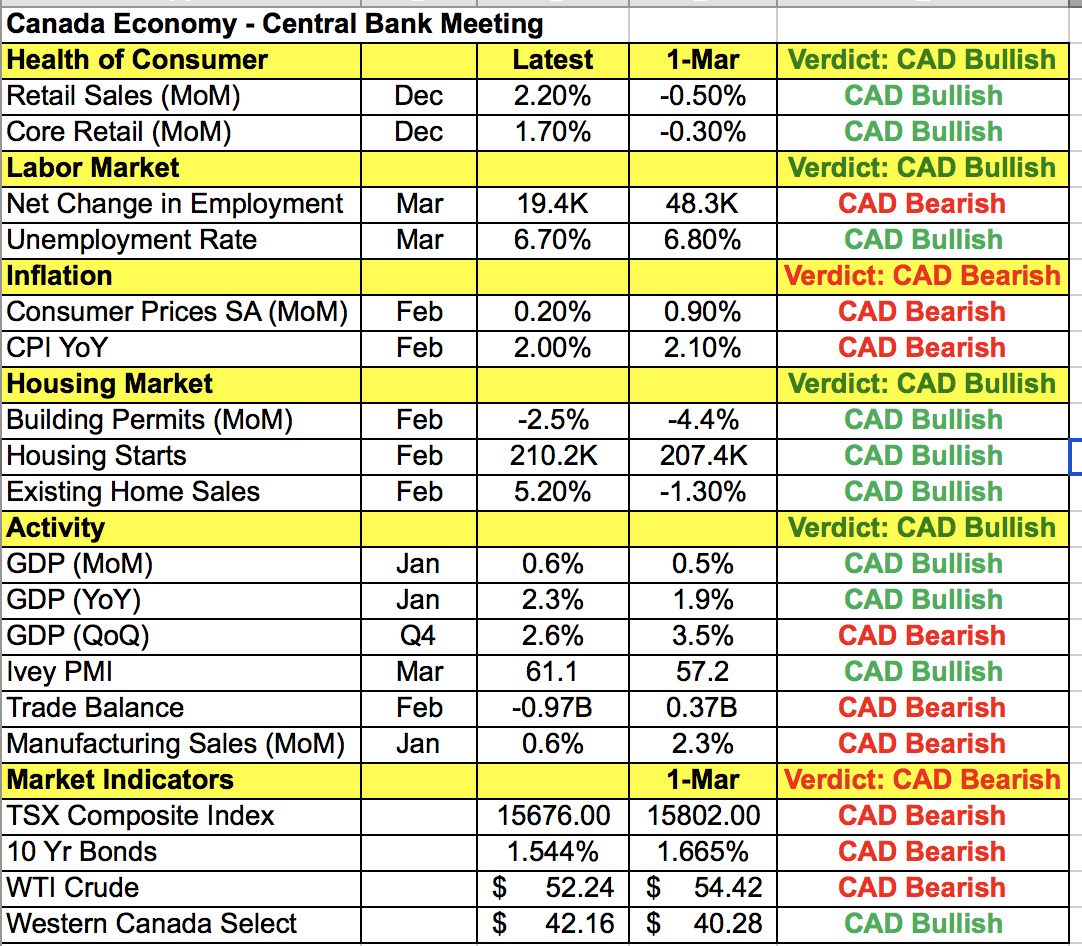
CAD Data Points
CAD Data Points
The Australian and New Zealand dollars traded lower this past week with AUD/USD reaching 75 cents on the back of risk aversion. The latest Australian economic reports were mixed with retail salesand manufacturing activity slowing while service-sector and trade activity grew. These contradictory reports created more confusion than clarity and gave investors very little reason to buy AUD. In the coming week, Australian labor data and China’s trade balance will be the numbers to watch. The RBA has recently expressed concern about the labor market, which makes this month’s report particularly important. China’s trade balance will most likely rebound after the unexpected deterioration last month. There’s quite support for AUD/USD at 75 cents but it is looking risky. As there are no major New Zealand economic reports scheduled for release in the new trading week, NZD will most likely take its cue from AUD, regional data and the market’s appetite for U.S. dollars.
After trading in an exceptionally tight range for most of the week, the euro finally broke down on Friday, falling to its lowest level versus the U.S. dollar in 3 weeks. The move had nothing to do with data as German industrial production and trade activity improved in February. Instead, ongoing terrorist attacks in Europe are making investors nervous about Marine Le Pen’s chances of becoming the next President of France. She is running on a campaign of anti-immigration, anti-terrorism and the latest polls show her virtually neck and neck with Emmanuel Macron going into the first round of voting on April 23. The latest terror attacks probably won’t make it into next week’s ZEW survey but we continue to expect the euro to trade with a heavy bias despite improving domestic conditions. At the same time, ECB officials are still worried about inflation — central bank President Draghi said this past week that it is clearly too soon to declare success on inflation and that ECB needs more inflation confidence to change its stance. As such, he sees no need to deviate from the wording of forward guidance even as the balance of growth risks seem to be shifting upward. ECB member Constancio agrees that it is too soon to declare success on inflation and Praet believes rates should stay at current or lower levels well past QE.
Finally, sterling ended the week lower against most of the major currencies. Data has been mostly weaker and is likely to worsen as the U.K. moves toward leaving the European Union. Although service-sector activity accelerated, manufacturing and constructionactivity slowed in March. Friday’s Halifax house price report, industrial production and the trade balance also missed expectations. Next week, we’ll get more insight into whether the hawkish dissent from BoE member Forbes at the last monetary policy meeting is justified. This past week’s data and the cautious comments from BoE member Vlieghe certainly puts her views into question. Vlieghe believes the BoE should be cautious as the U.K. consumer slowdown could intensify. The U.K.’s inflation and employment reports are scheduled for release next week. Inflation is an exceptionally important input into the central bank’s policy.


The Week Ahead: 5 Things to Watch on the Economic Calendar

© Reuters.  5 Things to Watch on the Economic Calendar In The Week Ahead

Investing.com - In the holiday-shortened week ahead, market players will focus on comments from Federal Reserve Chair Janet Yellen for further hints on the timing of the next U.S. rate hike and clues on how the central bank plans to pare back its balance sheet.
Investors will also keep an eye out on a few U.S. economic reports before the long Easter weekend, with Friday's inflation and retail sales data in the spotlight.
This week also marks the start of the first-quarter earnings season in the U.S.
Meanwhile, in the U.K., market participants will be looking ahead to reports on consumer prices and employment for further indications on the continued effect that the Brexit decision is having on the economy.
Elsewhere, China is to release what will be closely watched trade and inflation data amid ongoing concerns over the health of the world's second biggest economy.
Ahead of the coming week, Investing.com has compiled a list of the five biggest events on the economic calendar that are most likely to affect the markets.
1. Fed Chair Yellen Speaks
Federal Reserve Chair Janet Yellen is set to speak at the University of Michigan at 4:10PM ET (20:10GMT) on Monday. Audience questions are expected.
Her comments will be monitored closely for any new insight on policy and the timing of when the Fed will next raise interest rates.
The Fed chair could be asked about the U.S. central bank's plan to start shrinking its massive balance sheet, which ballooned to $4.5 trillion in wake of the financial crisis.
The Fed has not yet offered details on how it would reduce its holdings of Treasurys and mortgages but said it would like to start later this year.
Another topic of interest will be the Fed's concern that the stock market may be overvalued, as revealed in last week's minutes from the central bank's March policy meeting.
The Fed's next meeting is scheduled for May 2-3 while investors currently expect another rate hike in June, according to Investing.com’s Fed Rate Monitor Tool.
2. U.S. March Inflation & Retail Sales
The Commerce Department will publish March inflation figures at 8:30AM ET (12:30GMT) Friday. Market analysts expect consumer prices to ease up 0.1%, while core inflation is forecast to increase 0.2%.
On a yearly base, core CPI is projected to climb 2.3%. Core prices are viewed by the Federal Reserve as a better gauge of longer-term inflationary pressure because they exclude the volatile food and energy categories. The central bank usually tries to aim for 2% core inflation or less.
Rising inflation would be a catalyst to push the Fed toward raising interest rates.
At the same time Friday, the Commerce Department will publish data on March retail sales. The consensus forecast is that the report will show retail sales fell 0.1% last month, after gaining 0.1% in February. Core sales are forecast to inch up 0.2%, after rising 0.2% a month earlier.
Rising retail sales over time correlate with stronger economic growth, while weaker sales signal a declining economy. Consumer spending accounts for as much as 70% of U.S. economic growth.
Besides the inflation and retail sales reports, this week's calendar also features U.S. data on producer prices, initial jobless claims, as well as Michigan consumer sentiment.
Headlines from Washington will also be in focus, as traders await further details on U.S. President Donald Trump's promises of health care and tax reform.
3. U.S. Q1 Earnings Season Kicks Off
Wall Street's first-quarter earnings season kicks off this week, with major U.S. banks JPMorgan Chase (NYSE:JPM), Citigroup (NYSE:C) and Wells Fargo (NYSE:WFC) all reporting Thursday.
The financial sector is projected to post a 15.4% profit gain, second only to energy among S&P sectors, with revenue rising 7.5%.
For the broader market, earnings are forecast to grow 10.1% from a year ago, the best since 2014, while sales growth is expected to jump by 7.5%, the best since 2011, according to Thomson Reuters. data
A strong earnings season would help justify pricey stock valuations, with the S&P 500 rallying this month to its most expensive since 2004 on a forward price-to-earnings basis.
4. U.K. CPI & Employment for March
The U.K. Office for National Statistics will release data on consumer price inflation for March at 08:30GMT (4:30AM ET) on Tuesday. Analysts expect consumer prices to rise 2.3%, unchanged from a month earlier.
At 08:30GMT (4:30AM ET) Wednesday, the ONS will publish the monthly jobs report. The claimant count change is expected to fall by 3,000 in March, with the jobless rate holding steady at 4.7%. Wage growth including bonuses is forecast to rise 2.2%.
Recent data has pointed to signs that rising inflation, caused in part by the pound's post-Brexit vote tumble, is crimping spending by consumers, the main drivers of the economy, just as Prime Minister Theresa May begins Britain's EU divorce talks.
5. China March Trade Data
China is to release March trade figures at around 03:00GMT on Thursday (11:00PM ET Wednesday).
The report is expected to show that the country’s trade surplus widened to $10.0 billion last month from a surprise deficit of $9.15 billion in February. Exports are forecast to have climbed 3.2% in March from a year earlier, following a decline of 1.3% a month ago, while imports are expected to rise 18.0%, after increasing 38.1% in February.
Additionally, on Wednesday, the Asian nation will publish data on March consumer and producer price inflation. The reports are expected to show that consumer prices rose 1.0% last month, while producer prices are forecast to increase by 7.6%.
China's economy grew 6.8% in the fourth quarter, boosted by higher government spending and record bank lending. But the economy still faces headwinds from a cooling housing market and possible protectionist measures from the U.S.

Week Review: Top 6 Things That Moved Market This Past Week

© Reuters.  What will next week bring?

Investing.com – Take a peek at the top 6 things that rocked U.S. markets this past week.
The U.S. unemployment rate fell to a ten-year low
The Bureau of Labor Statistics reported Friday, Nonfarm payrolls grew by just 98,000 in March, well below expectations of 180,000, but the unemployment rate fell to a 10-year low of 4.5%.
Crude futures settled higher for a second straight week
Despite an unexpected rise in U.S. crude stockpiles to a record high on Wednesday, crude futures settled higher for a second straight week, buoyed by expectations that an OPEC-led deal to curb supply would be extended beyond June.
Shares of Tesla reached an all-time new high
Tesla (NASDAQ:TSLA) closed at a new all-time high, after the electric car manufacturer said it had delivered 25,418 cars in first quarter of 2017, a record for the company.
Fed minutes spooked investors
U.S. markets and the dollar experienced a sharp decline on Wednesday, after the Federal Reserve minutes, revealed that the U.S. central bank will start unwinding its $4.5 trillion balance sheet later this year.
Gold hit a five-month high
Although, Gold prices, retreated from a five-month high on Friday, the precious metal ended the week in positive territory, as demand for safe haven gold increased, after the United States launched a cruise missile attack against Syria.
The dollar got its groove back
The U.S. dollar index, shrugged off the mixed U.S. jobs report and moved above the 101 level on Friday, for the first time in three weeks, as investors remained optimistic that the U.S. Federal Reserve would hike rates in June.

Sunday, 2 April 2017

USD To Q1: 'Don't Come Back'


By Kathy Lien, Managing Director of FX Strategy for BK Asset Management.
The first quarter has come to an end and it was a tough one for the U.S. dollar. Even a rate hike by the Federal Reserve failed to stem USD's slide, which lost approximately 5% of its value against the Japanese yen and Australian dollar. The lack of urgency among U.S. policymakers to follow up the March hike in June was the main cause of the weakness but the failed health-care bill, tax-reform uncertainty and mixed data also contributed to the move. On Friday we learned that personal income and spending growth slowed in February with inflationary pressures easing according to core PCE. Manufacturing activity in the Chicago region accelerated, which along with healthier data Monday through Thursday helped USD/JPY end the week higher. That included stronger GDP growth, a narrower trade deficit and a sharp rise in the Conference Board’s consumer sentiment index. It's also worth noting that the greenback managed to shrug off a report that President Trump is studying ways to “penalize currency manipulators” as part of his goal to fight unfair trade. Such measures would be aimed at pressuring other countries to strengthen the value of their currencies at the expense of the U.S. dollar.
Looking ahead, USD/JPY has resistance at 112 and support at 111. It will be a big week for the U.S. dollar with ISM reports, minutes from the most recent FOMC meeting and nonfarm payrollsscheduled for release. If the minutes confirm that the Fed is in no rush to raise interest rates again, the dollar could retreat. But if they contain a general tone of optimism, we could see 113 in USD/JPY. With that in mind, NFP is the most important piece of data to watch because economists are looking for slower job growth. If they are right, it could be a nail in the coffin for the dollar, leading to lower trading in the next few weeks.
When the British government invoked Article 50 of the Lisbon Treaty, the E.U. responded and sterling didn't blink. Instead, U.K. financial markets acted quite orderly with GBP/USD ending the week within 50 pips of where it started. There were intraweek swings but given the historical significance of this week’s developments, the swings could have been far greater. We knew this day would come but its inevitability does not minimize its significance — the U.K. is leaving the European Union and investors, businesses and individuals are bracing for the fall-out. So far, the pain has been minimal with GBP/USD recovering part of its recent losses. Friday morning, the EU submitted its response to the Article 50, giving the U.K. 1 year after it leaves the Union to work on a trade deal and only if it settles its financial commitments. Its not the worst-case scenario because they are willing to talk trade. Nor is it the best-case scenario because Britain needs to first “show sufficient progress” on its settlement of the Brexit bill, a payment it has previously refused to pay. Scotland also officially requested a referendum. While we believe that all of these developments are negative for GBP, the currency is trading well and we have to respect the price action as a result. Sterling traders are taking the Article 50 trigger, EU response and Scotland’s call for a referendum in stride and if that continues, GBP/USD could squeeze up to 1.26. U.K. fundamentals will return to focus next week with the March PMIsscheduled for release. The recent hawkishness dissent in the Bank of England leads many to believe that the economy continued to improve last month.
It was a tough week for the euro. Although more than 30K people fell off German unemployment rolls and retail sales in the Eurozone’s largest economy grew strongly according to the most recent reports, inflation is moving in the wrong direction with CPI growth slowing to 1.5% from 2%. A number of ECB officials have talked about the possibility of a rate hike but we think that will be very difficult until inflation starts to rise. The first round of the French election will be a key focus in April and so far it appears that Emmanuel Macron holds a comfortable lead over Marine Le Pen. As April 23 nears, the euro’s sensitivity to the polls will increase significantly. In the meantime, the account of the most recent ECB meeting, German industrial production and trade along with U.S. data will drive EUR/USD flows. Technically, EUR/USD looks weak but there is also support near 1.0650.
Meanwhile, there was very little consistency in the performance of the commodity currencies this past week. The Australian dollar ended the week unchanged (though it performed well in the first quarter), the New Zealand dollar weakened and the Canadian dollar strengthened. AUD was supported by stronger Chinese data while faster growth in Canada and higher oil priceslifted the loonie. CAD GDP growth accelerated to 0.6% in January, driving year-over-year growth to 2.3% from 2.1%. AUD and CAD remain in play with the Reserve Bank of Australia’s monetary policy announcement and Canadian employment plus trade data scheduled for release next week. Business activity appears to have slowed a bit in Australia since the last monetary policy meeting but we’ll get more clarity with the release of retail sales and PMIs. Iron ore prices have also fallen, which means the Reserve Bank has less to be optimistic about in April. If it shrugs off these reports and remain positive, AUD will continue to outperform. However if RBA finally admits that the outlook may not be so bright, AUD/USD could come off its highs. CAD employment was very strong in February and is likely to retreat a bit in March. There are no major economic reports scheduled for release from New Zealand and no explanation for NZD's underperformance versus other currencies over the past week — aside from the possibility of month/quarter-end flows.